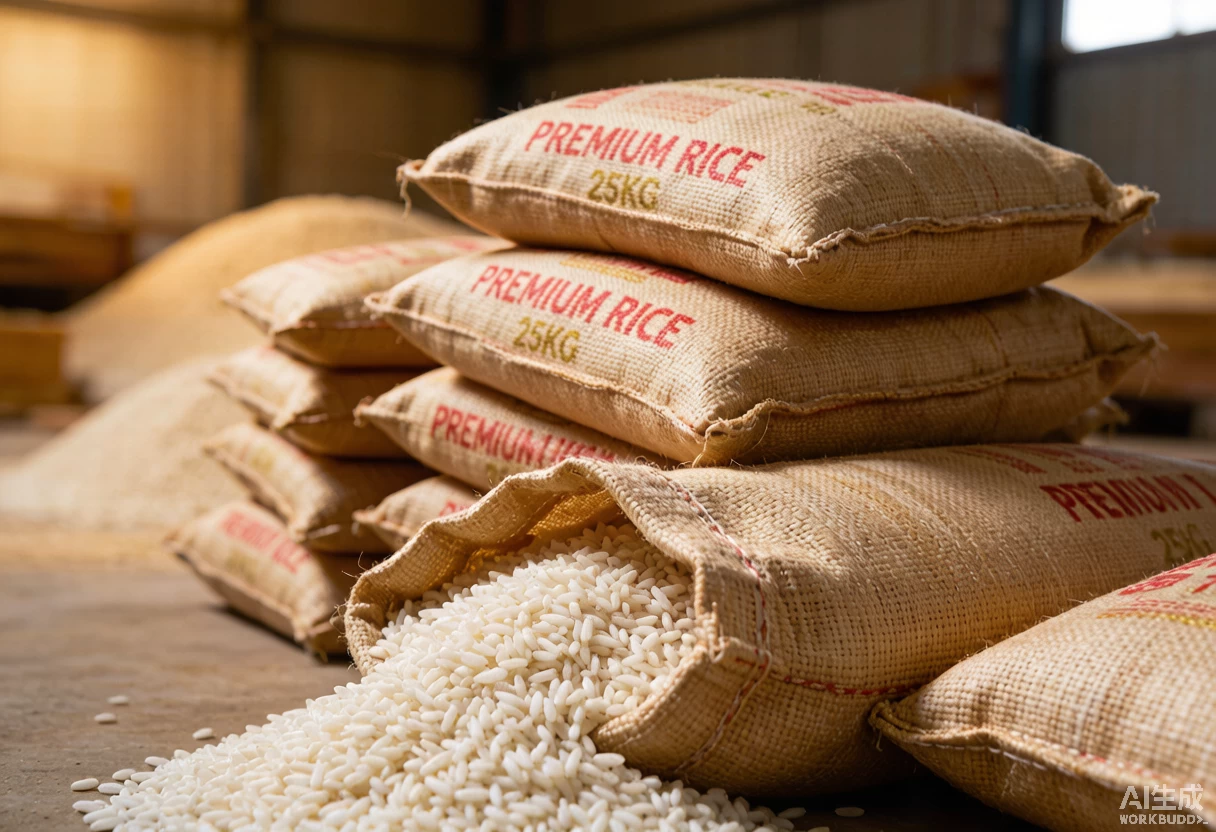
Quick answer: A quality PP woven rice bag is specified from the packed rice outward: target net weight, grain type, bulk density, filling and closing equipment, storage humidity, branding needs and the full distribution route. Material grade, fabric weight (GSM), weave density, lamination and seam construction must be confirmed together on a filled sample — never judged from nominal dimensions or bag weight alone.
Why rice bag quality matters in Southeast Asia
Southeast Asia is the world’s largest rice production and export region. Vietnam and Thailand alone ship millions of tonnes of milled rice every year, while Indonesia, the Philippines, Malaysia and Myanmar operate large domestic milling and distribution networks. Every one of those channels moves rice in woven polypropylene sacks — from 5 kg retail packs in supermarkets to 50 kg bags handled by millers, wholesalers and government distribution programs.
Rice is abrasive and dense. A 50 kg bag of milled rice has a bulk density around 780–850 kg/m³, and the sharp-edged kernels rub against the woven fabric every time the bag is lifted, dropped or stacked. Add the tropical climate — high humidity, heavy monsoon rain during the wet season and intense sun during dry months — and the packaging must survive conditions that would quickly break a low-grade bag.
Three quality failures are common in the Southeast Asian rice trade:
- Bag bursting during stacking. Rice is stored in tall stacks in warehouses and containers. The bottom bags carry several hundred kilograms of compression, so fabric strength and seam integrity must match the actual stack height.
- Moisture damage and condensation. In coastal climates and unventilated containers, condensation can form on the inside of the bag. A laminated or lined construction may be required for branded export rice.
- Print and brand damage. Export rice competes on shelf appeal. Poor ink adhesion, fading or delamination of the print layer ruins the brand image before the bag reaches the consumer.
A quality rice bag is therefore a complete package design: the right material grade, the right fabric specification, the right barrier layer and the right seam — validated with a filled-bag trial before mass production.
Materials: what makes a rice bag strong and safe
The starting point of bag quality is the polypropylene resin itself. Two material decisions dominate:
Virgin PP vs. recycled PP. Virgin polypropylene (often described as “new PP” or “100% virgin PP”) gives predictable tape strength, clean colour, low odour and consistent processing. Recycled or reprocessed resin is cheaper, but it can carry inconsistent melt flow, darker colour, odour and weaker tensile performance. For food-contact rice packaging, buyers should ask the supplier to confirm the resin type and, where relevant, food-contact compliance for the market of destination.
UV stabilizer and antioxidant. Rice bags are exposed to sunlight at loading docks, in open storage yards and during road transport. Without UV stabilization, PP tapes become brittle and crack after prolonged sun exposure. UV/antioxidant-doped resin is standard for bags that will sit outdoors in tropical conditions. Buyers sourcing for Vietnam, Thailand or the Philippines — where bags may wait for weeks in open yards before shipment or distribution — should specify UV treatment and ask how it is verified.
Masterbatch and colour. For coloured or printed bags, the pigment masterbatch must be dispersed evenly so the finished bag has a uniform shade from batch to batch. Cheap masterbatch can streak, bleed or fade quickly under tropical sun.
Ask your supplier to state the resin source for each order. The specification should name the material type, the UV treatment, and any food-contact or country-specific compliance claim — with documentation where required.
Fabric specifications: GSM, denier and weave
Once the material is fixed, the fabric specification determines how much weight the bag can carry and how it handles. Three numbers matter most:
GSM (grams per square metre). The fabric weight is the single most useful quality indicator. Heavier fabric generally means stronger fabric, and it is the number most suppliers quote when comparing constructions:
| Net weight | Common SEA size (W × L) | Typical fabric weight |
|---|---|---|
| 5–10 kg retail | 30 × 45 / 35 × 55 cm | 60–80 GSM |
| 25 kg | 45 × 75 / 50 × 80 cm | 100–120 GSM |
| 50 kg | 58 × 90 / 60 × 100 cm | 140–160 GSM |
These are reference values, not guarantees. A 50 kg bag for a rough stacking and handling route may need heavier fabric or a stronger seam construction than the minimum shown above.
Denier and weave count. Denier describes the linear density of the PP tapes; weave count (often written like 10 × 10, 12 × 12 or 14 × 14) describes how many tapes per inch in each direction. Together they control the fabric’s tightness and strength. A denser weave with well-oriented tapes resists puncturing and gives a smoother printing surface. Buyers should ask for the denier and weave count in the specification — “strong bag” is not a specification.
Fabric weight alone is not enough. The same GSM can be achieved with different tape widths and weave patterns that behave very differently when filled. Always require the full construction: material, denier, weave count, GSM, lamination, closure and bottom construction.
Lamination and printing for rice brands
Most branded rice bags in Southeast Asia use lamination to protect the print and improve the bag’s moisture performance. Two options dominate:
BOPP lamination. A biaxially oriented polypropylene film is bonded to the woven fabric, giving a glossy, smooth printing surface that reproduces high-resolution graphics. This is the standard for premium branded rice — 5 kg, 10 kg and 25 kg retail packs with vibrant logos, photos and cooking instructions. BOPP-laminated bags typically support 6–8 colour rotogravure printing.
PE coating or lamination. Polyethylene coating provides a moisture barrier and can also seal the weave so fine particles do not escape. Coated bags are common for rice that will be stored in humid conditions. The trade-off is that a fully coated bag is no longer breathable, so moisture management inside the bag must be confirmed — coated bags suit milled rice that is properly dried, while uncoated breathable bags suit applications where air movement is needed.
A transparent window is another option for rice and grain packaging: a clear panel lets the buyer see grain quality at retail while the printed area carries the brand. This is a popular middle ground for specialty rice and premium grains.
Whatever construction is chosen, the print and barrier decisions should be approved together on a sample — a beautiful print on a weak bag, or a strong bag with peeling lamination, are both quality failures.
Standard rice bag sizes for SEA packing lines
Rice packing lines in Southeast Asia are usually set up for fixed fill weights. The bag must match the filling spout, the bag holder and the closing station, not just the nominal weight:
- 5–10 kg retail bags — 30 × 45 cm to 35 × 55 cm, often BOPP-laminated with full-colour branding, sold through supermarkets and minimarkets.
- 25 kg bags — 45 × 75 cm to 50 × 80 cm, the standard for urban retail, wholesale and small-mill distribution.
- 50 kg bags — 56 × 90 cm to 60 × 100 cm, the workhorse for millers, exporters, bulk wholesale and government procurement.
Tell the supplier the fill weight, the filling equipment, the closure method (heat-cut, hemmed or sewn, with or without a folded top) and the stacking pattern. The usable fill height after closure is what matters for the packing line, so confirm headspace with the supplier rather than assuming the flat length is all usable.
Quality checks before you place a bulk order
A quality rice bag program is built on samples and inspections, not promises:
- Confirm the material and construction in writing — resin type, UV treatment, GSM, denier, weave count, lamination, closure and bottom seam.
- Test a filled sample with your actual rice. Fill to target weight, close as you will in production, and check for grain leakage, seam behaviour and filled dimensions.
- Run a drop test. A common benchmark is dropping a filled bag from 1.0–1.8 m onto concrete; confirm the method and pass criteria with your supplier.
- Stack and compress. Stack filled bags to your planned pallet and warehouse height and inspect the bottom bags after 24–48 hours.
- Check print adhesion and appearance. Rub the printed surface, check colour against the approved artwork, and confirm the print survives handling.
- Inspect production batches. Agree on sampling, dimensional checks (width, length, GSM) and how nonconforming bags will be handled before the order is released.
- Confirm export packing. Units per bale, wrapping, pallet or floor loading, labels and shipping marks — all of it affects how the empty bags arrive at your packing plant.
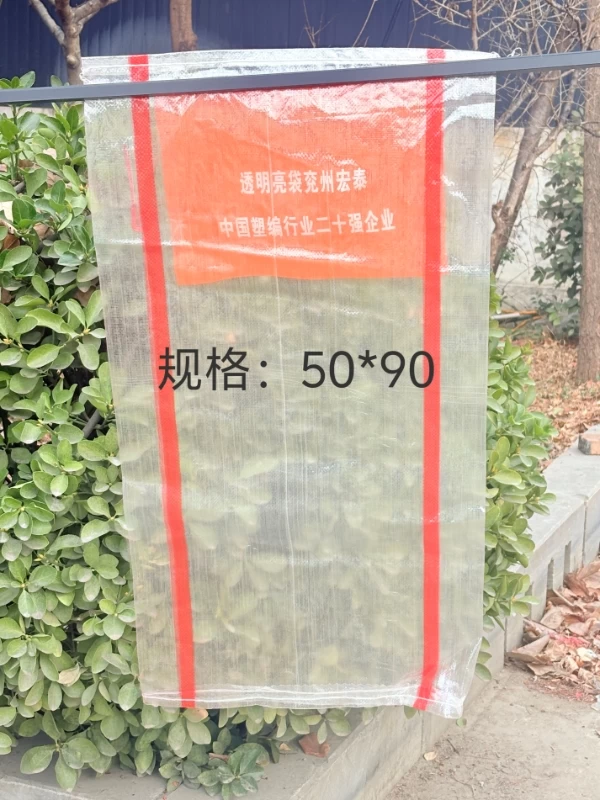
Hongtai’s reference bags — including the 50 × 90 cm transparent PP woven sack and the 60 × 100 cm transparent sack — are a starting point for discussing construction, not a promise of capacity. Approve the final specification against a filled sample for your own rice and route.
Application scenarios across Southeast Asia
Rice millers and processors (Vietnam, Thailand, Myanmar, Cambodia). High-volume 25–50 kg bags, emphasis on tensile strength, seam integrity and value for money. UV treatment matters where bags sit in open yards.
Rice exporters (Vietnam, Thailand). Branded, often BOPP-laminated bags for export containers. Moisture control and print quality are the two priorities, plus container-friendly packing that keeps bags clean and square.
Retail and specialty rice brands (Indonesia, Philippines, Malaysia). 5–10 kg retail bags with full-colour branding, transparent window options, and strong print adhesion for supermarket shelves under bright lighting and air-conditioned humidity.
Government and relief distribution. Large-volume 50 kg bags with plain or simple printing, consistent quality and dependable delivery schedules — reliability of supply matters as much as unit price.
Buyer FAQ
What is the difference between a coated and a laminated rice bag?
Coating applies a thin PE layer directly to the woven fabric; lamination bonds a separate film (usually BOPP) onto the fabric. Coating is mainly a moisture barrier; BOPP lamination provides a high-quality printing surface plus additional protection. The right choice depends on branding needs and storage humidity.
Is a higher GSM always better?
Not always. Higher GSM means heavier, stronger fabric, but it also costs more and changes filling behaviour. Choose the fabric weight that matches the fill weight, stacking plan and handling route, then validate it with a filled-bag trial.
Can PP woven rice bags be recycled?
Yes. Polypropylene is recyclable, and PP woven bags are often reused multiple times before disposal. Many suppliers can also incorporate recycled content into non-food-contact applications; confirm the material grade for food-contact rice packaging.
How do I know if the print will survive shipping and storage?
Ask for the print method (rotogravure is standard for BOPP), confirm the ink system, and test print adhesion and rub resistance on a sample. Approved artwork and a pre-production sample protect you against colour and legibility surprises.
What should I send for a rice bag quotation?
Send the rice type and moisture content, fill weight, bag size, filling and closing equipment, branding/artwork, storage and export conditions, quantity, packing and destination. Hongtai will confirm the specification, MOQ, production schedule and shipping options.
Get a factory quote for rice packaging
Send your rice type, fill weight, bag size, artwork and destination market through the Contact Us page. Hongtai will review the construction, confirm which details need a filled sample trial, and return a project-specific quotation for your Southeast Asian rice packaging program.